Posts

Java How To Program | Shopping Cart Application | Chapter #29 Ex #29.4 Solution
Image
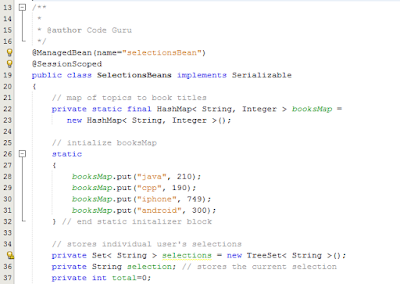
Shopping Cart Application: Using the techniques you learned in Section 29.8.2, create a simple shopping cart application. Display a list of books as an h:selectOneRadio element. When the user submits the form, store the user’s selection in a @SessionScoped managed bean. Allow the user to return to the list of books and make additional selections. Provide a link to view the shopping cart. On the shopping cart page, display the list of selections the user made, the price of each book and the total of all books in the cart. Code Snapshots: Output Screenshots: Home Page: Shopping Cart Page: Buy now CONTACT DETAILS For any other questions or other tasks please feel free to contact me via email: mhassnainjamil@gmail.com via WhatsApp: +92-324-7042178 via skype: hassnainjamil1
Cash Register program using Greedy Algorithm in Java with full source code

Cash Register program in Java 1. The driver class should initially fill the register with 0x$100, 0x$50, 10x$20, 20x$10, 20x$5, 0x$2, 50x$1, 80x$0.25, 50x$0.10, 20x$0.05, 100x$0.01 2. The program should ask the user the following: Make a sale make change print balances exit 3. For a sale: the program class should prompt for the cost and how much of each type of currency were given 4. If the register can not make the correct change, print an appropriate message 5. For making change: the program should ask which currency is being provided and how much of that currency, then it should output what currency is being given - example, make change, provide 4 quarters, register gives 1x$1 - example, make change, provide 50 dimes, register gives 1x$5 OR 5x$1 OR 4x$1, 4x$0.25 6. For print balances, just show what is currently in the register of every currency 7. Calculate Big-Oh for all 3 processes 8. Calculate actual operations for making a sale and print out (don't forget to include the cos...

Code Guru Store

Algorithm to find that a given binary tree is also balanced tree (AVL Type)

Image
AVL Tree Balance Tree Checker Algorithm: Design an algorithm which tests if an input binary tree is also balanced tree (AVL type). Prove algorithm's correctness and estimate its complexity. We're using appropriate format for the report according to the requirements Buy now CONTACT DETAILS For any other questions or other tasks please feel free to contact me via email: mhassnainjamil@gmail.com via WhatsApp: +92-324-7042178 via skype: hassnainjamil1 Buy directly from Sellfy products

COP 2800 (Java Programming I) Homework Full Solution

Image
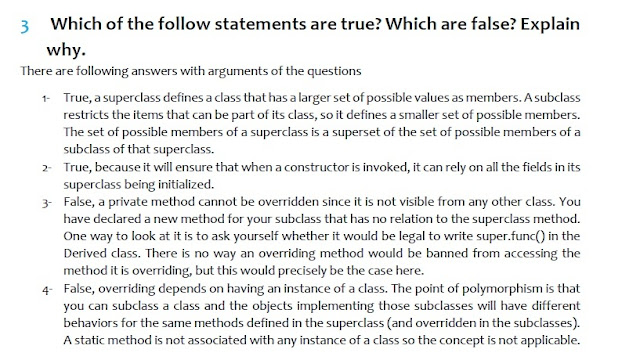
Object Oriented Concepts: (Inheritance, Polymorphism, Abstract classes, Interfaces, Exceptions and some other concepts)Answer the following questions as briefly (but completely) as possible: 1- What is the printout of running the class C (via the command “java C”) in the code below (saved in C.java)? (And, is that what you expected?) class A { public     A()     {         System.out.println("A's no-arg constructor is invoked");     } } class B extends A { } public class C { public     static void main(String[] args)     {         B b = new B();     } } 2- What problem do you expect to see if compiling the program below? What was the error(s), if any, actually produced? class A { public     A(int x)     {     } } class B extends A { public     B()     {     } } public class C { public     static void main(String[] args) ...

Geometer y and pricing inheritance program in C++ complete source code

Image
A class is a programmer-defined data type that describes what an object of the class will look like when it is created. It consists of a set of variables and a set of functions. A class is repository of functions that any main program may use. In this project you will create two classes and two main drivers to test the classes. Part I Part I will produce 2 files. Geometry.h file is the Geometry class with its members and functions. main cpp file tests all the code in the Geometry class. The textbook examples place the class code in the same file as the main function, but your code will be more re-usable if the class is defined in a separate file – Geometry.h . The header file will need to be included in the program as you did in the Airline Problem and the array.h file. The final version of the Geometry class (Geometry.h) will include: Three constructors:  Constructor 1 – receives 2 integer values for length and width. (rectangle) Calls checkNum to validate each value. Assigns val...

2015 Fall Computer Science I Program #3: Mastermind

Image
Introduction In the popular game Mastermind, one player creates a secret code of four pegs, each of which can be chosen from one of six colors. (The number of pegs and colors may be different than this in different versions, but your implementation will use these values, but be extendible to other values. Also, a color can be reused, thus there really are six choices for each of the four pegs.) The other player then has to guess the color of each peg, with the order mattering.The player who made the secret code then has to give feed back to the player guessing. This feedback is in the form of white and black pegs. A black peg means that the guesser has chosen the correct color in the correct slot. These are first “calculated” and awarded. Once these are counted, these pegs are ignored. Then the white pegs are awarded. These are for pegs that are the correct color but are in the incorrect slot. There is no “double dipping” of pegs in the response, so the sum total of white and black peg...